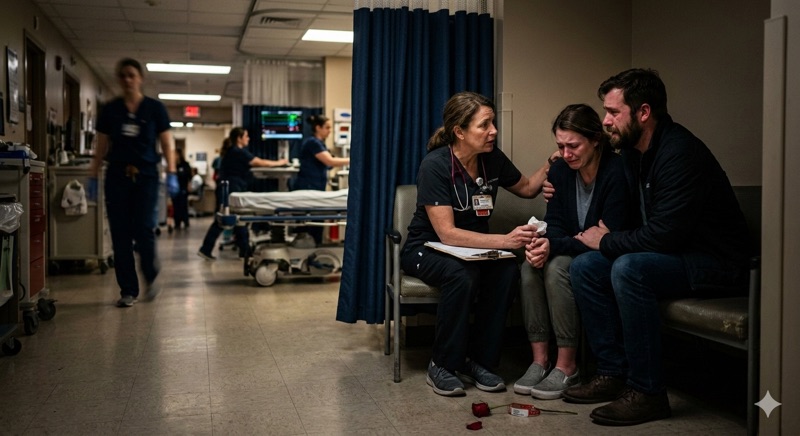
 Critical communications in ER
Effective communication in the Emergency Department (ED) regarding bad news and death declarations requires a shift from euphemistic language to direct, empathetic clarity. The GRIEV_ING protocol is the ED-specific standard, prioritizing the "Gathering" of family and "Identifying" oneself and the deceased before "Educating" on the events leading to death. Always use the words "dead" or "died" to prevent cognitive dissonance. For sudden death, immediate notification is essential, while termination of resuscitation (TOR) should ideally involve family presence if feasible, as this facilitates the grieving process and reduces post-traumatic stress.
Clinical Review: Communication and Death Declaration in the ER
1. Frameworks for Breaking Bad News (BBN)
While the SPIKES protocol is widely used in oncology, the GRIEV_ING protocol, developed by Hobgood et al. (2005, updated 2013) and adopted by the Society for Academic Emergency Medicine (SAEM), is specifically tailored for the abrupt nature of ED deaths.
- G (Gather): Ensure all appropriate family members are present in a private, quiet space.
- R (Resources): Mobilize support systems immediately (social work, chaplaincy, or additional family).
- I (Identify): Identify yourself, your role, the patient by name, and the state of the family's knowledge.
- E (Educate): Briefly describe the events leading up to the arrival or the resuscitative efforts in the ED.
- V (Verify): State clearly that the patient has died. Avoid phrases like "passed away," "left us," or "expired."
- _ (Space/Silence): Allow for the "emotional impact" of the news; do not rush to the next step.
- I (Inquire): Ask if there are immediate questions.
- N (Nuts and Bolts): Discuss organ donation (via OPO), funeral home arrangements, and the need for an autopsy or medical examiner (ME) involvement.
- G (Give): Provide a business card or contact information for follow-up questions.
2. Communication Nuances and Linguistic Clarity
A 2023 study by Orlandini et al. highlights that the use of euphemisms in the ER often leads to "incomplete comprehension," where family members may believe the patient is in a coma or a deep sleep.
- The "D-Words": Physicians must use "dead," "died," or "death." These terms provide the cognitive closure necessary to begin the grieving process.
- The Warning Shot: Before delivering the final news, provide a brief preparatory statement (e.g., "I have very difficult news to share").
- Non-Verbal Communication: Maintain eye level, avoid physical barriers (like a desk), and use "therapeutic touch" only if culturally appropriate and welcomed.
3. Family Presence During Resuscitation (FPDR)
Current guidelines from the American Heart Association (AHA) and the Emergency Nurses Association (ENA) support FPDR when a dedicated staff member (chaperone) can remain with the family to explain the interventions.
- Clinical Insight: Families who witness resuscitative efforts often report a more "natural" transition to the death declaration because they have visual evidence that "everything was done."
- Contraindications: FPDR should be avoided if the family is highly disruptive or if the resuscitation involves forensic evidence collection (e.g., violent crime).
4. Procedural Declaration and Legal Requirements
The clinical declaration of death in the ED involves a systematic physical exam followed by administrative duties.
- Physical Verification:
- Absence of central pulses (carotid/femoral).
- Absence of heart sounds for a full 60 seconds.
- Absence of spontaneous respiratory effort.
- Fixed, dilated pupils.
- Check for "The Lazarus Phenomenon" (autoresuscitation); current literature suggests observing the patient for 5–10 minutes after stopping CPR before final declaration.
- Medical Examiner (ME)/Coroner Cases: In most jurisdictions, any death occurring within 24 hours of hospital admission or resulting from trauma/violence must be reported. Physicians must not remove lines (ET tubes, IVs, catheters) in ME cases to preserve evidence.
- Organ Donation: Federal Law (CMS) requires hospitals to notify the local Organ Procurement Organization (OPO) for every death. Physicians should not approach the family about organ donation themselves but should facilitate the introduction of an OPO coordinator to avoid a perceived conflict of interest.
5. Termination of Resuscitation (TOR) Communication
When communicating the decision to stop CPR, the physician should frame the decision as a clinical "limit of medicine" rather than asking the family for permission.
- Example Phrasing: "We have used all the medications and procedures available to restart your father's heart, but unfortunately, his body is not responding. At this point, additional efforts will not be successful, and I am going to stop the resuscitation."
- Psychological Impact: This relieves the family of the "guilt of the decision," placing the burden on the clinical futility of the situation (Abramson et al., 2024).
6. Post-Mortem Care and Physician Wellness
Recent literature (2024) emphasizes the "Pause"—a 30–60 second moment of silence in the trauma bay after a death declaration to honor the patient and allow the team to recalibrate. This practice has been shown to mitigate moral injury and secondary traumatic stress among ER staff.
7. Counseling/Debriefing Room Protocol
It is recommended to always use a quiet, calm environment for communication. Ideally, the room should feature sofas or lounge chairs with no table placed between the parties to foster openness.
These rooms may be equipped with audio-visual recording capabilities. Bystanders and participants must be informed that the session is being recorded and that the footage will be kept strictly confidential. Clear signage regarding recording must also be displayed vividly on the wall. These records are essential for future medicolegal purposes.


